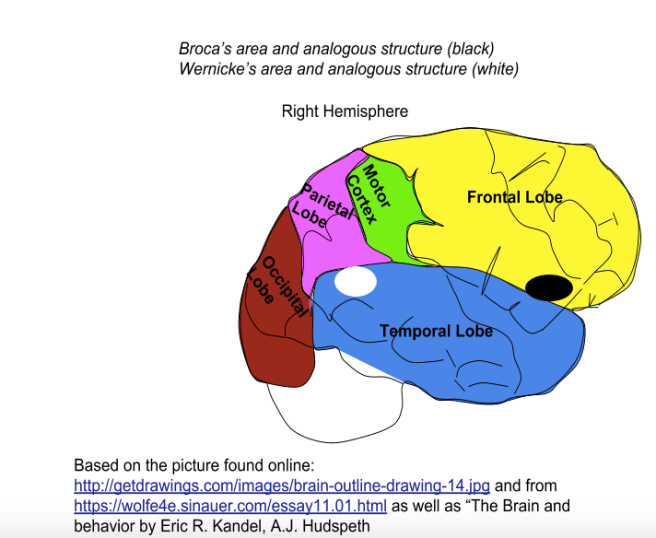
According to “The Brain and Behavior” by Eric R. Kandel and A.J. Huspeth, Broca’s area along with Wernicke’s area and the analogous zones of the right hemisphere have distinct processing functions that are interconnected during the process of speech and word comprehension. According to the aforementioned source, Broca’s area (in the frontal lobe) is responsible for the understanding of sentence structure and syntax, the underlying rules dictating the way in which we speak (According to Wernicke’s model of distributed processing, Broca’s area also has some motor functions). In contrast, Wernicke’s area (in the temporal lobe) is related to the understanding of a word’s meaning, not necessarily its emotional connotations, but rather its definitions. In this way, Wernicke’s area is described as receptive rather than expressive (although Broca’s area is not solely used for expression). Keeping this distinction, the analogous structure to Broca’s area in the right hemisphere of the brain is responsible for the expression of emotional nuance in speech with regards to the ways in which words are pronounced and sentences are structured. Furthermore, the analogous structure to Wernicke’s area is responsible for the understanding of various intonations and the multiple ways in which the same word might be expressed to elicit an emotional response. Ultimately, the innate capacity for language is predicated on all of these regions but the distinction of a “natural language” highlights how Broca’s area (and perhaps the analogous area in the right hemisphere) is perhaps most critical. As the brain has developed over time, it is important to keep in mind that it is a series of processing units. As language was initially being developed, certain structures and syntax were most conducive to understanding as they could be most easily processed and replicated. Thus, imbedded within all of us are specific rules of grammar that allow our brain to wrap our head around various languages most easily. (I used “The Brain and Behavior” by Eric R. Kandel and A.J. Hudspeth for this assignment)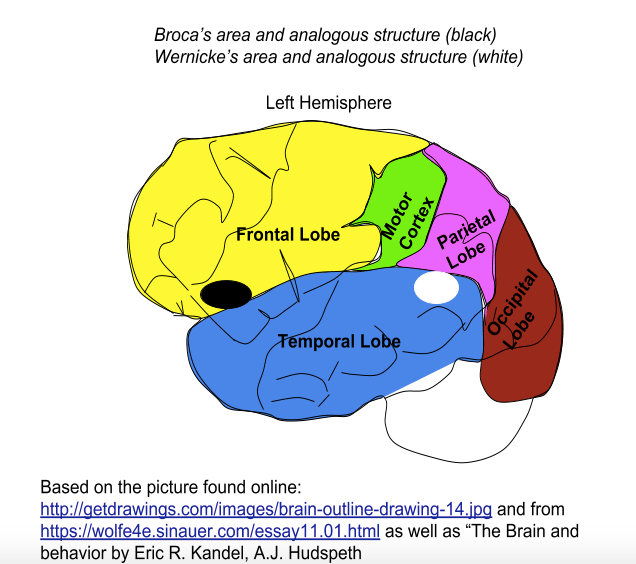
The Brain and Behavior

Published
 Colin's Neurological Discoveries