Emergence occurs when a system of parts is able to accomplish tasks or is imbued with certain features that are only brought about by the act of the combination of said parts as these components combine their traits and properties in a way that forms a novel body.
The complex psychological phenomena we experience on a daily basis regarding our persona and our emotional tendencies that make us feel uniquely human can be distilled, or rather reverse-emerged, down to relatively simple components. In the same way that the majority of rationale and language processing often occurs in very specific sections of the brain (the left hemisphere), “affective elements” (The Brain and behavior, Erik R. Kandel, A.J. Hudspeth) of our psyche cause interconnected sections of our brain to become active and to promote these intangible, often fleeting feelings. Ultimately, neural synapses and brain cells located in certain areas of our brains (for the most part the right hemisphere) and communicating with electrochemical signals control our temperament and thought processes with chemicals and other means with which to disrupt our homeostatic nature.
The compound eye of arthropods as we know them today serves as a major clue regarding the development of vision among organisms. In terms of the evolution of such an eye, there are two conflicting schools of thought as to whether the compound eye was originally present in onychophorans (not a true arthropod) or whether the eye evolved later, once the arthropod lineage truly came to be. (en.wikipedia.org) The arthropod eye has similar functional elements with regards to the human eye with cones and lenses while also having novel receptive elements such as the rhabdom (the replacement for rods). (www.britannica.com) The Ommatidium, the eye of flies and other arthropods, also contains various pigment cells that affect eye color (www.ncbi.nlm.nih.gov), aid in perception, and contribute to the overall structure of the eye (the eye actually generates more of these cells than is required, causing some to lyse (www.ncbi.nlm.nih.gov)). (www.sdbonline.org)Much as this eye has similar or analogous features to the human eye, the function is comparable as light is inflected via the lense, passes through various receptors and is shuttled to the brain via optic nerve(s). (en.wikipedia.org) The arthropod eye is one of nature’s most elegant examples of emergence as structural and sensory elements come together to form a system that allows arthropods to detect danger or food in their surroundings. A pigment cell, cone, or lens could accomplish none of these tasks on its own, yet the ocular complex mimics the structure of some of the world’s most perceptive eyes. (www.ncbi.nlm.nih.gov)
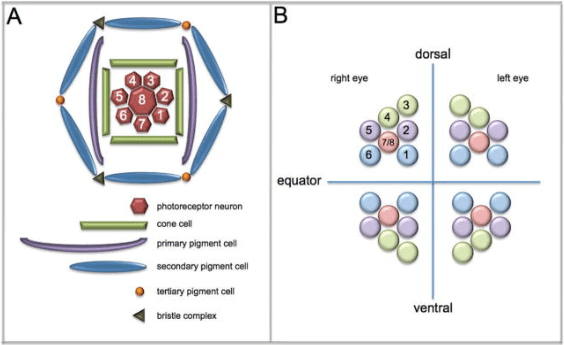 (www.ncbi.nlm.nih.gov)
 Colin's Neurological Discoveries